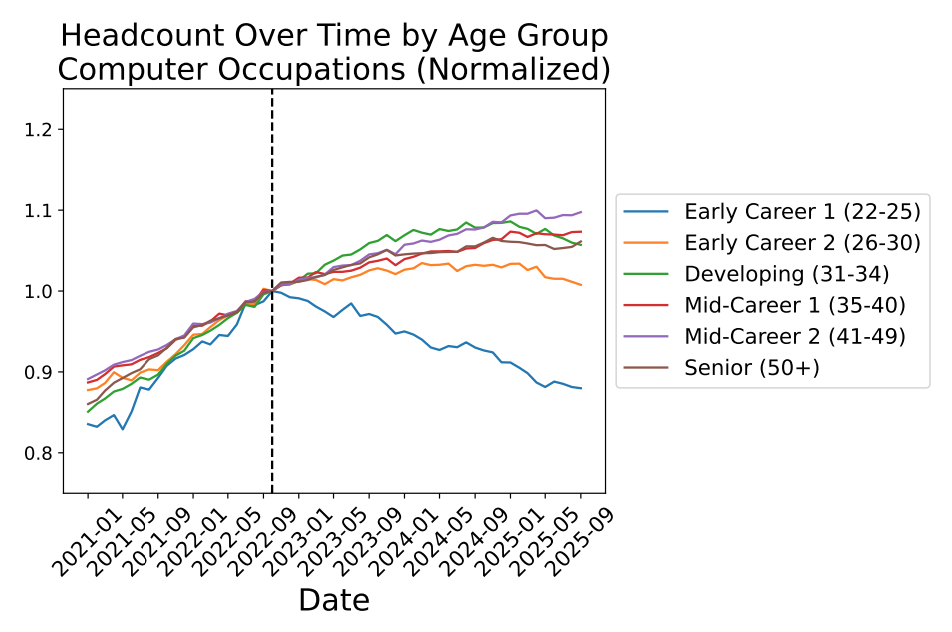
We’ve all heard it: AI is coming for junior-level jobs. If you are in your 20s and you use a computer for work, you have already been affected . Plenty of handwringing ensued . But fear not, it is an illusion.
To a first approximation, junior work is about getting tasks done when tasks are specified, while senior work is about judgement, taste, and handling ambiguity when nothing is specified. If AI completes whole classes of well-specified knowledge work faster and more cheaply than any junior employee ever could, then from where will the next generation of senior people be found?
The assumption doing all the work here is that junior people prepare for senior roles by doing junior work. The apprenticeship myth claims that performing non-senior tasks in proximity to a senior person is adequate (ideal?) preparation for a junior person to one day take on the role of the senior person.
We should subject this load-bearing claim to scrutiny.
In some fields, the apprenticeship myth never really took hold. Medical residencies don’t teach surgery by having residents mop floors, they have residents do surgery (with supervision). Future airline pilots aren’t sent to load baggage for a few years, they fly simulators, trainers, and then passenger jets alongside experienced officers. It is perhaps telling that when competence is a life or death issue, a profession lacks the luxury of having its interns spend their days aligning text boxes in PowerPoint.
But high stakes professions are not the only ones to have skipped over the apprenticeship myth. Young people learn tennis by playing tennis, not stringing rackets. Budding musicians spend hours playing a piano, not tuning it. Artists spend more time painting than washing brushes.
Junior work is not without its benefits. Junior people work in proximity with others and learn from them. Important interpersonal and communication skills develop. Relationships form early that create a network of trusted colleagues one can rely on later. Juniors may also gain tacit knowledge about how decisions are made, where risk hides, and how to take accountability when things break. But stripped of the apprenticeship myth, the benefits of junior work start to resemble simply the benefits of work, benefits that accrue as a result of sustained collaborative effort regardless of level.
Junior work may have benefits to the profession, rather than to the junior person doing it. Junior work may help the profession identify the juniors most committed to it, best able to persevere, most loyal or most culturally compatible (willing to work evenings and weekends, for example).
The apprenticeship myth also reassures senior people. It’s comforting to believe your own junior suffering was somehow essential. But this was likely never true.
Back in the day, some bankers started out balancing accounts on vast paper spreadsheets. Some executive assistants spent their early years in the steno pool. Some architects and civil engineers paid their dues as draftsmen. Yet we didn’t run out of bankers, secretaries and architects when their junior equivalents were automated away. Quite the contrary: Excel created more analyst positions, not fewer.
In every case, the “junior work” exploded in scope and ambition. Senior work became junior work, and junior employees were freed up to learn and succeed doing it. This in turn allowed the best senior people to take on newer higher work that was previously unthinkable. The entire workforce shifted upwards, like a line of growing hermit crabs trading up into bigger shells.
This suggests a second and darker driver of the apprenticeship myth’s longevity. AI puts junior people in competition with senior people who have not yet found that newer higher work to which they must now direct their efforts. Even with decades of experience, if a recent graduate can approximate your output, you are now a junior person. Senior people hold on to the apprenticeship myth not only to justify their past but to hang on to it. They haven’t yet found the next bigger shell to make their new home, even as they eye the hungry crows circling above.
As an aside, we are also likely to discover the vapidity of much senior work. If junior tasks can be automated, maybe much of what passes for judgment and taste can be too , we just haven’t tried yet.
So take a breath. In a few years, young people will leave school and take on the responsibilities of today’s Senior Vice Presidents. The kids will be alright.
Will you?
What I’m reading:
“The org chart is shrinking. The question for every executive is whether they will be among the three who remain, or among the seventy who discover their roles were coordination overhead all along.” (The Coordination Tax )
“AI is steel for organizations.” (Steam, Steel, and Infinite Minds )